Mission Control
Agent orchestration for developers who ship with AI. Give your agents a team, a process, and a budget.
The Problem
You have AI agents. Maybe one writes code. Another reviews it. A third runs tests. But right now they're disconnected — separate prompts, separate contexts, separate sessions. You're the glue. You copy outputs between them, track what's done, estimate costs, and hope nothing goes sideways while you're not looking.
Mission Control gives your agents a team structure. They pass work to each other, inherit context from completed tasks, and you watch the whole thing from one place.
A Real Pipeline
This isn't a mockup. We ran this pipeline on March 9, 2026. Five specialized agents, each reading the previous agent's output, building an Agent Health Dashboard feature from scratch:
Each agent runs in its own context window — clean isolation, predictable costs. The only shared state flows through explicit dependency chains. The QA engineer has never seen the PRD, but it reviewed code that was built from a design that was informed by that PRD. Structure does the work.
What It Looks Like
Dark mode, clean layout, no clutter. Built with shadcn/ui.
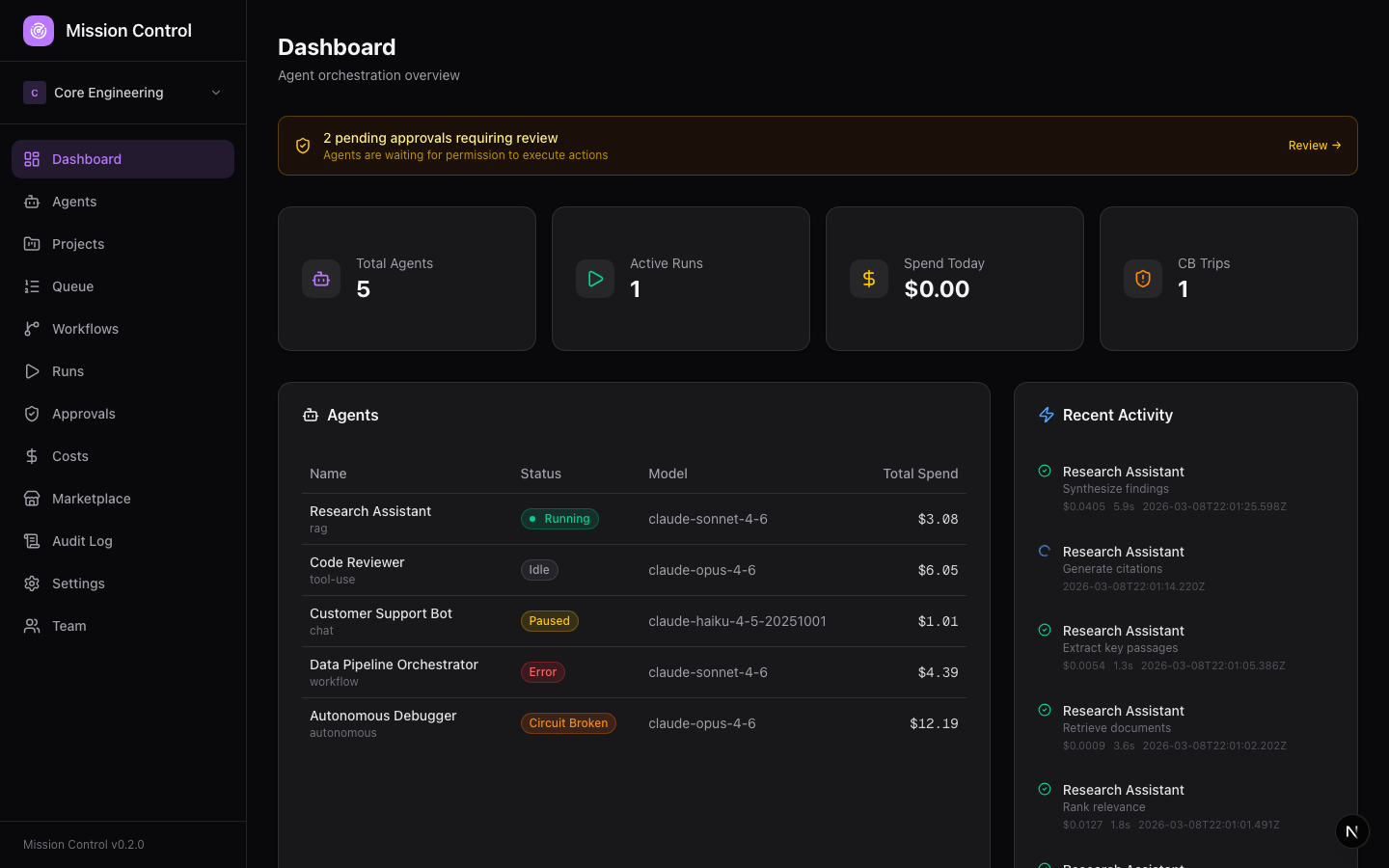
Dashboard
Fleet overview — agent status, active runs, spend, and recent activity at a glance.
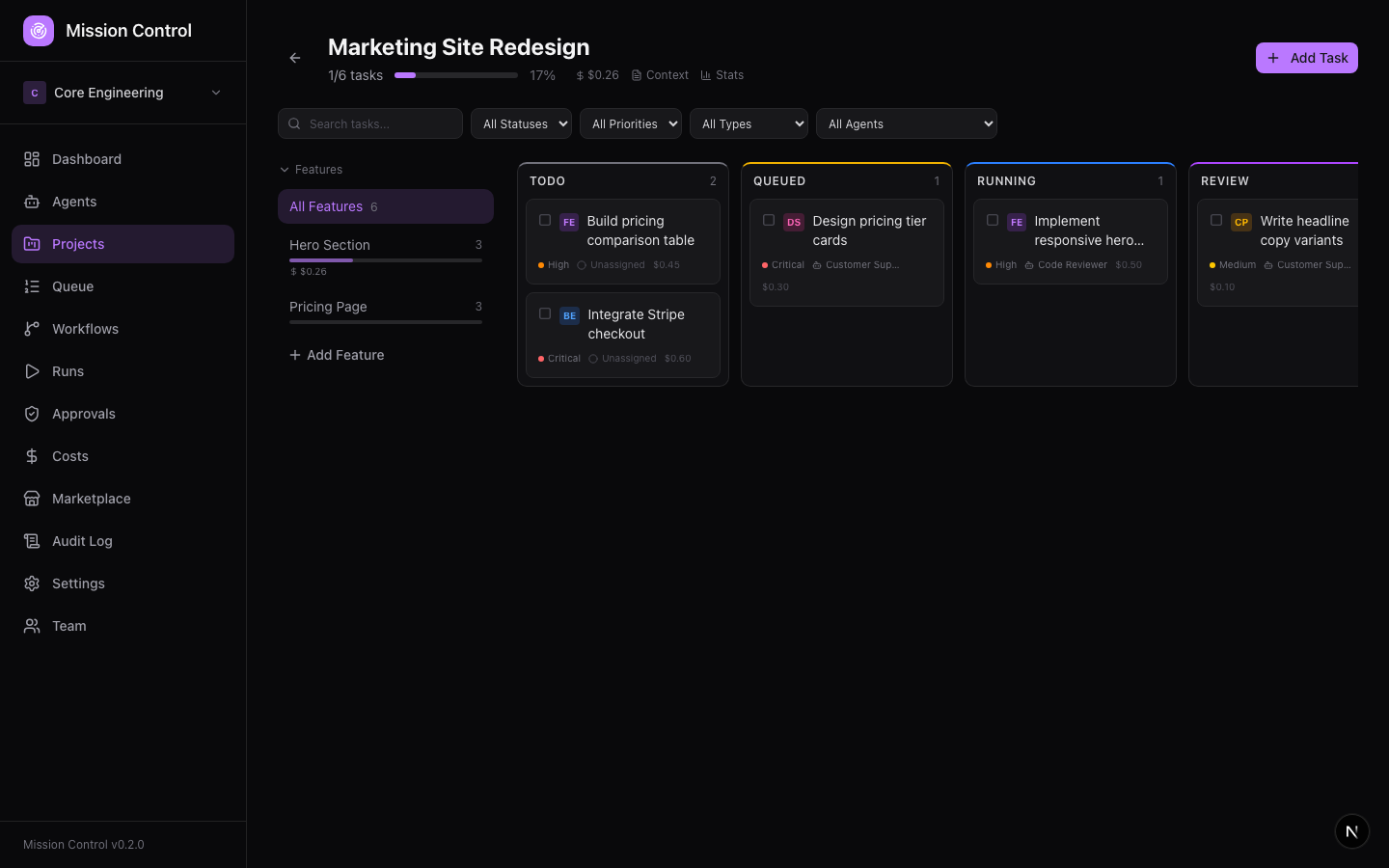
Project Board
Kanban view with tasks grouped by feature. Drag between columns, track costs per task.
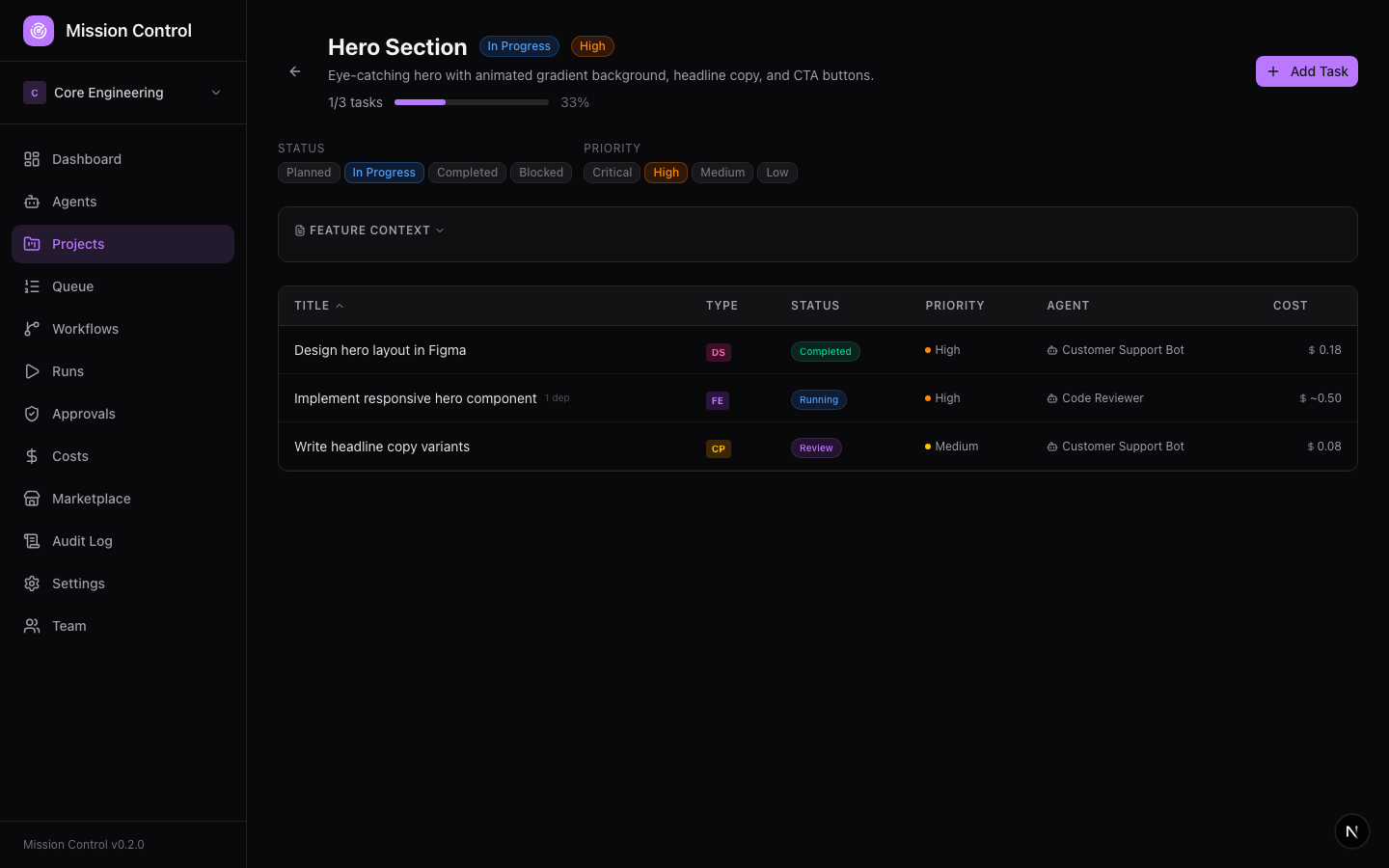
Feature Breakdown
Drill into any feature to see task-level progress, agent assignments, and per-task costs.
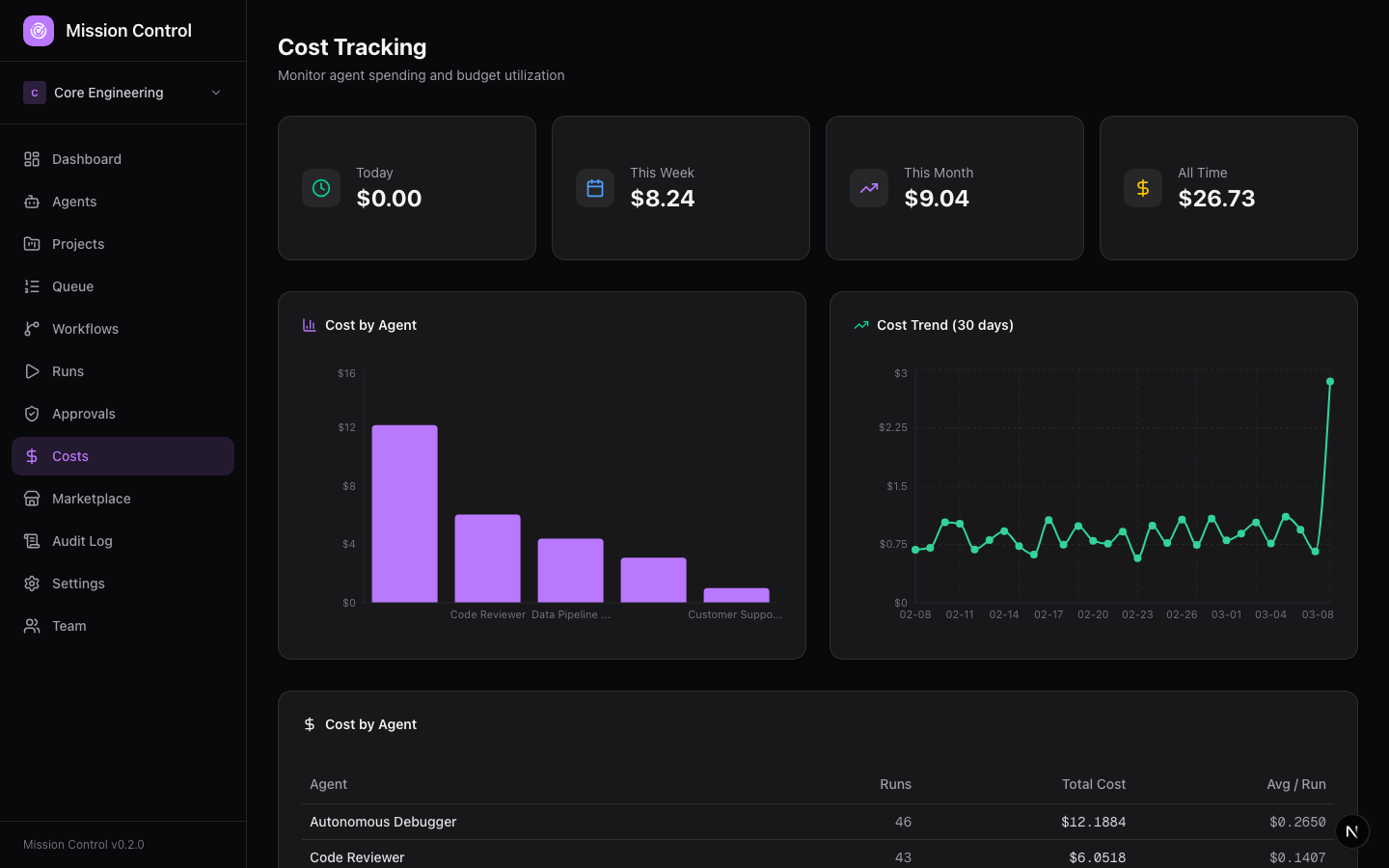
Cost Tracking
Per-agent spending, 30-day trends, and per-run cost breakdowns. Know exactly what you're spending.
Three Pillars
Workflows
Route events to specialized agents. Define pipelines with dependency chains. DAG editor for complex orchestration.
Observability
Real-time agent progress via SSE. Cost tracking per task and per run. Health monitoring and alerting.
Project Management
Kanban boards for agent work. Context inheritance — each task knows its project, feature, and siblings.
How It Works
Context Inheritance
Agents receive the full context stack automatically — project goals, feature requirements, completed sibling tasks, and dependency outputs. Zero prompt engineering.
Clean Isolation
Each agent task is a standalone API call with its own context window. No shared memory, no context pollution. Predictable costs, predictable behavior.
Dependency Chains
Tasks declare dependencies. The executor resolves them topologically and passes completed outputs forward. The QA engineer reads the developer's actual code.
Role-Based Prompts
Each agent type gets a system prompt that defines its expertise. The Product Manager thinks about personas. The Staff Engineer thinks about risks. Same model, different minds.
What's Built
- Projects, features, and tasks with kanban boards
- Context inheritance across the full project hierarchy
- Dependency resolution with topological sorting
- Execution bridge with direct Anthropic API streaming
- Role-based agent system prompts (PM, Designer, Staff, Coder, QA)
- Per-task cost tracking from actual API usage
- SSE real-time updates across the UI
- Spending caps and circuit breakers
- Approval gates for high-risk operations
- Multi-agent workflow editor (DAG)
- Audit log with rollback capability
- Workflow marketplace with ratings
The Stack
// Local-first. No Docker. No external DB.

framework: "Next.js 16"

language: "TypeScript"

styling: "Tailwind + shadcn/ui"

database: "SQLite (better-sqlite3)"

realtime: "Server-Sent Events"

agents: "Anthropic API (streaming)"

tests: 228 // and counting
Where We Fit
Building in the Open
Mission Control is under active development. We ship weekly and we don't hide behind waitlists.
Follow on GitHub